Pax Silica is a new concept that has recently been developed via a United States-led economic and security coalition. Technological interoperability is at the heart of strategies to oppose Chinese aggression in the IndoPacific region. The State Department led meetings in Washington, DC started in December 2025 with seven nations signing a Pax Silica Declaration to mutually secure global supply chains for advanced technologies, including artificial intelligence (AI), semiconductors, and critical minerals.
A key concept is Quantum Supremacy or, in other words, the advantage of quantum computing over classical supercomputers.
Quantum supremacy refers to the moment where a quantum computer solves a problem that no classical supercomputer can finish in any practical manner without taking an exponential number of years. In 2019, Google claimed to have created Quantum hardware that could outperform traditional computers on a specific task. The catch is that the specific task in Google’s demonstration had no immediate real-world use.
Definition: Quantum Supremacy is defined as physical superiority of quantum computing over classical limits. Classical computing uses on and off switches, whereas with quantum computing a switch can be off and on at the same time. The mysterious phenomenon of quantum entanglement underlies the ability to correct errors resulting from the degree of randomness that results from the ambivalence of a switch being on and off at the same time.
Entanglement: Qubits (similar to a bit but indicating a unit of quantum information) simultaneously process huge amounts of data at the quantum level — particles that exist at the subatomic level. Classical computers work by tracking bits sequentially. In 2019, Google announced it had achieved Quantum Supremacy using their 53-qubit Sycamore processor for a random sampling task.
In 2010, China initiated previous trade restrictions, Rare-earths have grown in importance in a variety of supply chains; according to Reuters, China’s latest restrictions might cause more damage to Japan’s economy than China’s 2010 efforts to intimidate Japan.
Corporate notices about critical minerals are signaling trouble ahead for Japanese industries that depend on Chinese rare-earth products. Japan’s pain, however, may not be commensurate with CCP frustration towards Japan’s leadership in the developing coalition of nations prepared to stand with Taiwan, the Philippines and other U.S. allies.
Symbol of Philippine national Pride. The Carabao symbolizes, strength, power, efficiency, perseverance and most of all, hardwork. Philippine president Emilio Aguinaldo declared the Carabao a national symbol due to its aid in the First Philippine Revolution.
China reported no exports to Japan of terbium or dysprosium oxide from November through May and minuscule shipments of yttrium oxide since December, cutting off supplies critical to making powerful magnets. Tokyo is working with Australia, the U.S. and other nations to develop alternatives and also has products on which the Chinese economy depends. Japan is investing alongside the U.S. and other allies to secure supplies of rare-earths and other strategic minerals. Australia and the Philippines are two nations in which such resources have been identified. But developing infrastructure for mining and processing rare-earths will take many years.
Takaichi signed a framework with U.S. President Donald Trump in October to stockpile critical minerals and rare-earths. Mining of deep-sea deposits remains in the distant future.
The Group of Seven nations has agreed to do more to coordinate stockpiles, and Japan has rare-earth recycling projects in progress.
“I assume that a year of export restrictions will create big problems and we’re four to five months into that. Obviously, the government wants to keep the issue under wraps so as not to cause panic and give China the early win.”
Yuriy Humber, CEO of Tokyo-based Yuri Group, a consultancy.
China’s economy is hurting. Japan and the U.S. have not even begun to feel the pain. Nevertheless, the global economy is decoupling and the pressure will be on Europe and other industrial nations to restrict trade with China. China will ratchet up its sanctions and continue provoking low-level confrontations such as regular law enforcement patrols East of Taiwan. And China has violated territorial rights within the Exclusive Economic Zones of various sovereign nations. Testing ICBM missiles within Japanese airspace is serious enough to challenge Japan’s national security without provoking a full scale war. Claiming islands in the South China Sea and the Philippines as Chinese territory creates a sense of normalcy to China’s expansive ambitions.
China’s newest claim is that the Philippine Island of Batanes belongs to China. China has experts claiming that Batanes belongs to China
Batanes is an island close to Taiwan—and therefore strategically located for launching missiles in defense of Taiwan. Although a Chinese invasion of Taiwan is anticipated to expand into the Philippines, there is no basis in history or international law for the claim that Batanes has historically belonged to Taiwan; nor is there any recognition from the international community that China has any claim to Batanes.
🇵🇭 Reality Check: Batanes has been an integral part of the Philippines for centuries. The Ivatan people are Filipino—not subjects of Beijing. No treaty, map, or internationally recognized legal instrument grants China sovereignty over Batanes.
China already lost its sweeping maritime claims against the Philippines. The 2016 South China Sea Arbitration tribunal unanimously rejected the legal basis for Chinese claims in the South China Sea. Inventing new claims over Batanes exposes the desperation behind propaganda allegedly spewed by CCP apparatchiks in China’s academic community.
One of the major themes we deal with on this blog site is national security and related issues. Almost from the beginning of the Trump Administration’s attacks on Iran, there has been intense dissension. Within a short time after the U.S. began carrying out strikes on Iran in coordination with Israel on Saturday, Feb. 28, 2026, the chattering class began questioning why regime change was not happening and why the onslaught against the Iranian regime failed to produce a deal that satisfied all of the Trump administration’s demands. And the Trump Administration allegedly lied because Trump stated previously that all three sites the U.S. hit in June, 2025 had been obliterated. A U.S. intelligence assessment subsequently found that only one of the locations had been destroyed.
Trump Abandoning Taiwan? But an arguably more subtle criticism developed after the President’s trip to China. The usual suspects suggested that Trump and his administration had signaled to Xi Jin Pang that the U.S. is preparing to abandon Taiwan.In 1955, the U.S. had entered into a Mutual Defense Treaty with the Republic of China (Taiwan). The treaty was in effect until 1979 when President Carter recognized Communist China and abrogated the previous recognition of Taiwan. Article 10 of the treaty stipulated that either party could terminate the treaty one year after notifying the other party. The treaty came to an end on January 1, 1980, one year after the United States established diplomatic relations with the People’s Republic of China on January 1, 1979.
Taiwan Relations Act. The U.S. commitment to defend the island of Taiwan from invasion by the People’s Republic of China was replaced by the Taiwan Relations Act of 1979. The existing Taiwan Relations statute does not promise Taiwan direct military assistance in case of an invasion. The policy for many years has been for U.S. foreign policy to remain ambiguous regarding the consequences of Chinese aggression in the Strait of Formosa.
Incidentally, Pres. Carter’s authority to unilaterally annul the U.S. treaty with Taiwan, was the topic of the Supreme Court case Goldwater v. Carter. SCOTUS declined to rule on the legality of this action on jurisdictional grounds, thereby allowing Carter to discard Taiwan as an ally had it not been for the U.S. Congress stepping into the breach with malleable assurances of assistance pursuant to the Taiwan Relations Act.
Trump’s possible intention to delay arms shipments to Taiwan gave rise to accusations that he secretly had agreed with Xi Jinping not to oppose Chinese actions against Taiwan. For example, the Center for American Progress (CAP) announced that the Taiwan alleged arms freeze is a gift to Xi Jinping. By freezing the $14 billion arms package to Taiwan, the Trump administration supposedly was “abandoning historic U.S. commitments, damaging Indo-Pacific deterrence, and inviting Beijing’s aggression.”
In 2008, CAP outlined a progressive approach to U.S. China relations, stating that the next president should concentrate on six policy priorities in U.S.-China relations:
Climate change and energy security
Balanced and sustainable global growth
Enhanced security in the Asia-Pacific region
China’s military modernization
Stability in the Taiwan Strait
Governance and individual rights.
Predictions of Doom for Taiwan. The media reports echo CAP’s dire predictions regarding Taiwan. The problem is that significant news has been almost completely overlooked by the President’s detractors. The Quad is a diplomatic partnership between the United States, Australia, India, and Japan committed to fostering a free and open Indo-Pacific. The cooperation initially began with the 2004 Indian Ocean earthquake and tsunami, which claimed over 225,000 lives across 14 countries. Together, the Quad mobilized 40,000 emergency responders – along with helicopters, cargo ships, and transport planes – to assist affected countries.
Since then, Quad partners have worked together for regional stability and security. The Quad is a diplomatic partnership between the United States, Australia, India, and Japan committed to fostering a free and open Indo-Pacific.
Quad partners have worked together in response to natural disasters and broader challenges to economic prosperity and regional stability and security as a coalition for a free and open Indo-Pacific prepared for “contingencies” that threaten the region. On May 28, 2026, Japan and the Philippines announced an agreement to engage in talks leading up to an agreement to share classified information. Japan has already agreed to allow Tokyo to step up transfers of military equipment to Manila, including warships.
Multinational Security Ties. Tokyo and Manila have been steadily upgrading defense and security ties in response to China’s growing assertiveness in the South China Sea and against Taiwan. Japan’s relaxation of longstanding restrictions on combat equipment exports is a direct result of Trump Administration policies. A proposed weapons transfer pact will allow Tokyo to provide used destroyers to Manila’s navy.
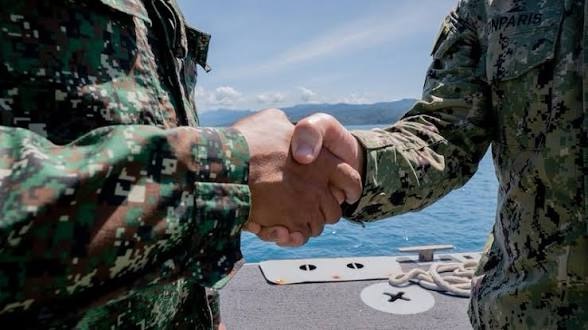
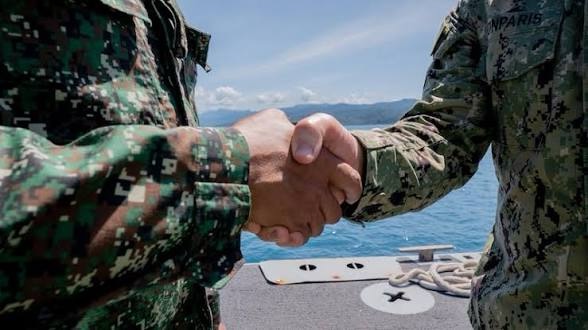
Japan and the Philippines are broadening defense ties between the two nations, which are both treaty allies of the United States. Seventeen countries, including India and Australia, traveled to Paoay, in northwestern Philippines, for an annual combat exercise. The Balikatan military exercise displayed U.S., Philippine, Japanese and Canadian firepower with a mock allied assault sinking a ship about 40 kilometers (25 miles) off the coast.
The story of how the Founding Father of modern China ruthlessly subjugated his own people and set the scene for China’s thrust toward world domination
Signals to China. The message to China is that aggression against Taiwan will be countered with long range fire-power that can reach the Formosa Straight and even the Chinese mainland. Chinese officials have accused the Philippines of allowing countries led by the U.S. to “gang up” against China.
New American, South Korean and Japanese ships. The Philippines is set to receive transfers of American and Japanese vessels to bolster its Coast Guard and Navy fleets operating in the South China Sea. The U.S. is building a network of ammunition hubs throughout the First Island Chain with recent development of Olongapo-Subic Bay resurrecting the former U.S. Naval presence under terms that encompass ship building and other military operations subsidized and/or funded by the United States.
Shangri-La Dialogue. The International Institute of Strategic Studies (IISS) Shangri-La Dialogue in Singapore hosted American and Japanese defense officials who pledged to reinforce Manila’s fleet with recently and soon-to-be decommissioned vessels. The Philippines is involved with several other nations, including the U.S., to modernize forces toward operations aimed at deterring Chinese aggression. The conventional wisdom is that the Philippines is in a strategic location that ties its own defense to the defense of Taiwan.
2012 standoff at Scarborough Shoal. The Philippine Navy and Coast Guard have been supplemented with new South Korean and Japanese maritime assets to offset China’s initial moves in the South China Sea following a 2012 standoff at Scarborough Shoal.
Mutual Defense Treaty. On May 3, 2023, the U.S. Department of Defense (DOD) of the United States of America and the Department of National Defense (DND) of the Republic of the Philippines established Bilateral Defense Guidelines to modernize and strengthen the 1951 United States-Philippines Mutual Defense Treaty’s (MDT’s) continued relevance in addressing current and emerging threats:
● Face emerging regional and global security challenges;
● Coordinate defenses in the region and address primary security concerns; and
● Guide priority areas of defense cooperation to address security challenges of shared concern to the United States and the Philippines.
Although the defense guidelines were promulgated under the Biden administration, recent developments have demonstrated the Trump Administration’s solid commitment to sharing resources between the Quad nations and other countries threatened by China’s ambitions in the South China Sea and Indo-Pacific region.
The destiny of the Philippines nation therefore seems to be closely connected to the fate of Taiwan and other nations aligned with the U.S. in the region. Infrastructure, intelligence, distribution of goods, including military armament and natural resources are all components of the emerging coalition that is solidifying within the Indo-Pacific region.
Japan, Australia and the Philippines all have located substantial deposits of rare earth elements. China stopped sales to Japan of certain metals and products using rare elements in order to intimidate Japan from implementing its industrial and defense strategies. Missiles, electric vehicles and computer technology all require large amounts of rare metals. China presently monopolizes the mining, distribution and production of rare metals.
The United States and other nations are desperately trying to identify sources of these metals but developing environmentally sound methods of mining and refining such materials will take years. Therefore, the U.S. government is expected to subsidize such development both domestically and in other nations, with sharing arrangements that include the Philippines and Japan. Such efforts are closely connected to mutual defense.
The Philippines seems to have a unique role to play in world affairs. The Filipino culture is a peace-loving one with deep reverence for the things of God. Many seemingly prophetic indications point toward great riches being stored in the vast chain of Philippine Islands. Not the least is the youth. Large Philippine families raise disciplined children who tend to be well-educated and aware of opportunities that are coming on their nation.
A vast diaspora of highly-trained Filipinos living all over the world maintains intimate family connections back in the Philippines. Such a large number of young people is in itself a resource for a nation requiring a skilled workforce that is ready to deploy for war when needed. Most Americans are unaware of these developments and have no sense of the powerhouse already being revealed in the Philippines and the whole Indo-Pacific region.
The Ecclesia is on the move in the Philippines and across the globe. The Greek word for church is Ecclesia. Those who are summoned out of the world to administer the Kingdom of Heaven in the Earth.
The conventional wisdom within the foreign policy establishment has been that China depends on U.S. markets too much to risk its apparent stability by invading Taiwan and the Philippines. The problem with China is it is not so stable right now. Xi’s position as a Chinese strongman has been weakened by a series of economic catastrophes. The dearth of oil shipments from the Strait of Hormuz impacts Japan, Taiwan and the Philippines more than China because of China’s stockpiles of oil and gas.
Nevertheless, China’s economy is teetering and all its carefully prepared plans for war may go for naught unless its military moves now. And that is why its neighbors are stepping up to the plate with help from the U.S. The fact that the previous reliance on the U.S. for defense is a thing of the past creates risks and opportunities that the mavins of mass media have not even begun to contemplate.
It might be worth remembering that the so-called McCarthyite witch-hunts started because of allegations that certain claques within the foreign policy establishment praised Mao after WW II and supported abandoning Chiang Kai-shek, the military commander and head of the Nationalist Chinese government in China from 1925-1948, and the first President of Taiwan through 1975. A staunch U.S. ally throughout World War II U.S. and an ally of the Free World. During the Cold War, Chiang received little or no respect from the liberal news outlets!
The time is coming when the nations of this world will come under Christ’s rule. For now, God has delegated power to restrain evil. God has ordained that magistrates bear the sword to restrain evil-doers. While some nations are coming under such authority, other regimes conspire to scorn that which God has ordained. We are seeing this process as nations align in ways unexpected coalitions. The stage is being set for dramatic events!
China is now kicking and screaming while the news gurus moan about Trump abandoning a nation to which most of the chattering class never gave much thought except to castigate the Right-wingers that once made an issue of Taiwanese sovereignty and the abrogation of our treaty with Taiwan’s government.
“Take no part in the worthless deeds of evil and darkness; instead, rebuke and expose them.”
Ephesians 5: 11
The Philippines is just one of the many countries worldwide where journalists, lawyers and judges are slain and their killers go free. Mexico is also very dangerous for anyone that reports on the cartels and the cartels routinely eliminate large numbers of police officers within any city where the authorities take a stand against cartel domination. Mexico is a nation where almost every firearm in the hands of its own people is illegal.
Even Mexican police officers are often disarmed when off duty because so many of them have been involved in the murder, rape and slavery perpetrated by the cartels across whole regions. So can the Philippines learn anything from Mexico?